
COMFIT Maternity Pads
The Fourth Trimester: The Part of Motherhood We Don’t Talk About Enough
Every Birth Creates Two New Lives
Every birth marks the beginning of two new lives. One belongs to the baby. The other belongs to the woman becoming a mother. Yet while family and friends rush to celebrate the newborn; with tiny clothes, congratulatory messages, photographs and gifts, another story quietly begins in the background. A story of healing. A story of recovery. A story of resilience. It is a chapter that rarely receives the same attention, despite being just as important as pregnancy itself. Healthcare professionals around the world have a name for this period. They call it the Fourth Trimester. And perhaps it deserves far more conversation than it gets. Mothers first choice, COMFIT Maternity Pads
What Exactly Is the Fourth Trimester?
For nine months, almost every conversation centres around pregnancy. Regular antenatal appointments, nutrition, hospital preparations, baby names, nursery decorations. Birth plans. Families prepare meticulously for the arrival of a child. But remarkably few prepare mothers for what comes after childbirth.
The first twelve weeks following delivery, commonly referred to as the Fourth Trimester, represent one of the most physically and emotionally demanding periods in a woman’s life.
According to the American College of Obstetricians and Gynaecologists (ACOG), postpartum care should be viewed as an ongoing process rather than a single medical check-up, recognising that a mother’s physical recovery, emotional wellbeing and long-term health require continuous attention [ACOG, 2018].
Similarly, the World Health Organization (WHO) emphasises that quality postpartum care is essential not only for newborn survival but also for protecting maternal health, preventing infections, supporting recovery and improving overall wellbeing [WHO, 2022].
Childbirth may last hours. Recovery often lasts weeks… or even months.
The Recovery Nobody Talks About
The reality is that bringing a baby into the world places extraordinary demands on the human body. Following delivery, a mother’s body begins an intensive process of healing.
The uterus gradually contracts back to its normal size.
Hormonal changes continue long after birth.
Energy levels fluctuate.
Sleep becomes fragmented.
Breastfeeding introduces new physical demands.
At the same time, postpartum bleeding, known medically as lochia, continues as the body naturally sheds blood and tissue while healing. For many women, this can last anywhere from four to six weeks, sometimes longer. Despite being completely normal, it is one of the least discussed parts of motherhood. Yet it influences almost everything: comfort, mobility, confidence, rest. The ability to care for a newborn. The ability to simply feel like yourself again. Recovery is not a side note to childbirth. It is part of childbirth.
Why Comfort Is More Than a Luxury
When people think about postpartum recovery, they often focus on medical care. Doctors, medication, hospital visits. But healing also happens in ordinary moments. Standing up. Walking around the house. Feeding your baby. Sleeping whenever you can. Receiving visitors. Taking your first shower after delivery.
These moments may appear small. To a recovering mother, they are significant milestones. This is why healthcare professionals often recommend products like COMFIT manufactured by Globe Spinning Mills Limited from BHOJSONS Group of companies. It is specifically designed for postpartum recovery rather than relying on standard sanitary pads. Postpartum bleeding is heavier. Recovery is more sensitive. The body needs products capable of providing greater absorbency, enhanced comfort and reliable protection. Comfort, in this context, is not about indulgence. It is part of recovery itself.
Dignity Is Part of Healing
There is another word that deserves more attention in conversations about motherhood. Dignity. Every mother deserves to recover without constantly worrying about leaks. Without discomfort. Without irritation. Without compromising her confidence during one of life’s most vulnerable seasons.
The United Nations Population Fund (UNFPA) continues to advocate for dignified maternal care that respects women’s health, comfort and wellbeing throughout pregnancy and after childbirth, recognising that recovery is not simply a medical process but a deeply human one [UNFPA, 2021].
When women feel secure, they move more comfortably. They rest more confidently. They focus more fully on bonding with their baby. Sometimes, the greatest gift a product can offer isn’t convenience. It’s reassurance.
Some Products Solve Problems. Others Restore Confidence.
This understanding has shaped maternity care products around the world. Because postpartum recovery is different, mothers deserve products designed specifically for that stage; not simply adapted from everyday hygiene products.
This is the philosophy behind COMFIT. Developed specifically for maternity care, COMFIT Maternity Pads are designed to provide the kind of protection recovering mothers genuinely need. Every feature reflects an understanding of postpartum recovery.
Superior absorbency helps manage heavier postpartum flow with confidence.
Ultra-soft materials provide comfort for sensitive skin during healing.
Reliable leak protection offers reassurance throughout the day and night.
Comfortable support allows mothers to focus less on discomfort and more on recovery.
This isn’t simply about hygiene. It is about helping mothers recover with greater comfort, confidence and peace of mind.
Why Trust Matters During Recovery
When it comes to maternal care, trust isn’t built overnight. It is earned over years. Sometimes generations.
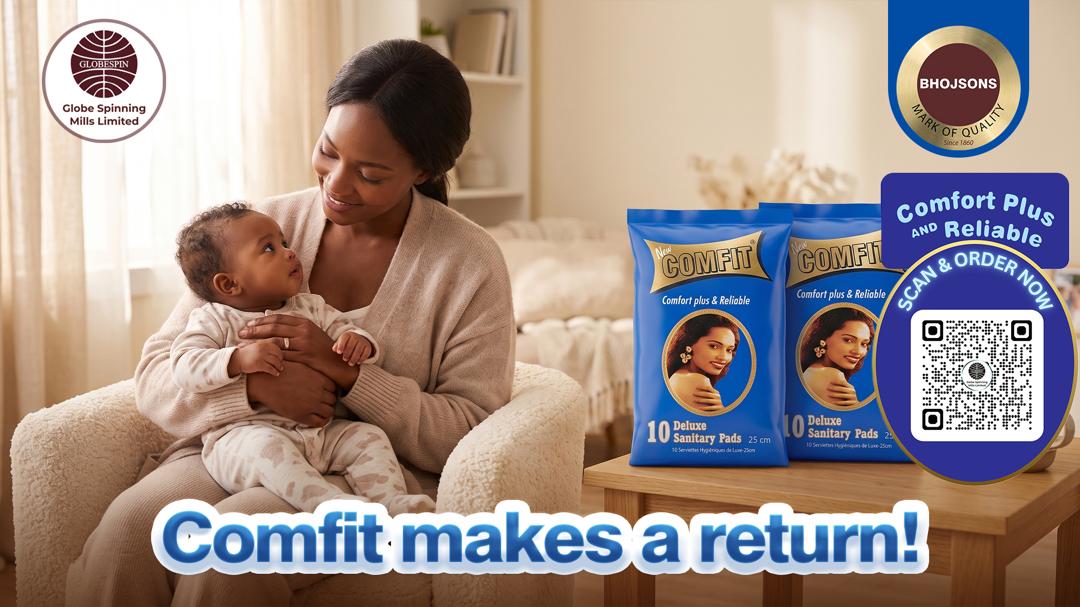
COMFIT returns to Nigerian families backed by Globe Spinning Mills Limited, a proud member of the BHOJSONS Group, carrying forward a legacy of manufacturing excellence that traces its roots back to 1860.
Its return is not driven by trends. It is driven by something much more meaningful. The continued confidence of healthcare professionals. The requests of retailers. The recommendations of mothers who experienced its quality first-hand. In healthcare, products become trusted because they consistently perform when people need them most. That is the reputation COMFIT returns with.
Because Care Never Goes Out of Demand
Some products disappear from shelves. Few disappear from people’s memories. Over the years, enquiries continued, recommendations continued and demand continued. Today, COMFIT returns to the Nigerian market with renewed purpose. Not simply to reintroduce a product, but to continue supporting mothers through one of the most important journeys of their lives. Because while technology evolves and markets change, one truth remains constant: Every mother deserves exceptional care.
Care Should Also Be Easy to Access
Recovery should never be complicated. Recognising this, COMFIT’s relaunch also introduces a simple way for customers to access the product quickly. By scanning the dedicated QR code included across campaign materials and product communications, customers can place orders instantly and conveniently. No unnecessary searching, no delays. Just simple access when it matters most. Because after childbirth, mothers have enough to think about already. Finding trusted postpartum care products shouldn’t be one of them.
What Every New Mother Should Pack in Her Hospital Bag
While every birth experience is different, healthcare professionals often recommend preparing a hospital bag well before the expected delivery date.
Essentials typically include:
- Comfortable nursing gowns
- Nursing bras
- Baby diapers
- Baby wipes
- Toiletries
- Extra underwear
- Comfortable slippers
- Water bottle
- Healthy snacks
- Phone charger
- Going-home clothes
- COMFIT Maternity Pads designed specifically for postpartum recovery
Planning ahead allows mothers to focus less on logistics, and more on welcoming their baby into the world.
Caring for Mothers Is Caring for Families
Healthy babies deserve celebration. Healthy mothers deserve just as much attention. Behind every thriving newborn is a woman whose body is healing, whose life has changed, and whose strength often goes unseen. Supporting that recovery isn’t simply about healthcare. It’s about compassion. It’s about dignity. It’s about recognising that motherhood doesn’t end in the delivery room, it begins there.
As COMFIT returns to Nigerian homes, it brings back more than a trusted maternity care product. It renews a promise. A promise that every mother deserves comfort. Every mother deserves confidence. And every mother deserves care that lasts beyond childbirth, because a healthy baby changes a family. A cared-for mother changes everything.
References
- World Health Organization (WHO). (2022). WHO recommendations on maternal and newborn care for a positive postnatal experience.
https://www.who.int/publications/i/item/9789240045989 - American College of Obstetricians and Gynecologists (ACOG). (2018). Optimizing Postpartum Care (Committee Opinion No. 736).
https://www.acog.org/clinical/clinical-guidance/committee-opinion/articles/2018/05/optimizing-postpartum-care - United Nations Population Fund (UNFPA). (2021). Maternal Health Thematic Fund.
https://www.unfpa.org/maternal-health - United Nations Children’s Fund (UNICEF). Maternal and Newborn Health.
https://www.unicef.org/health/maternal-and-newborn-health
- National Health Service (NHS), UK. Your body after the birth.
https://www.nhs.uk/pregnancy/labour-and-birth/after-the-birth/your-body/